
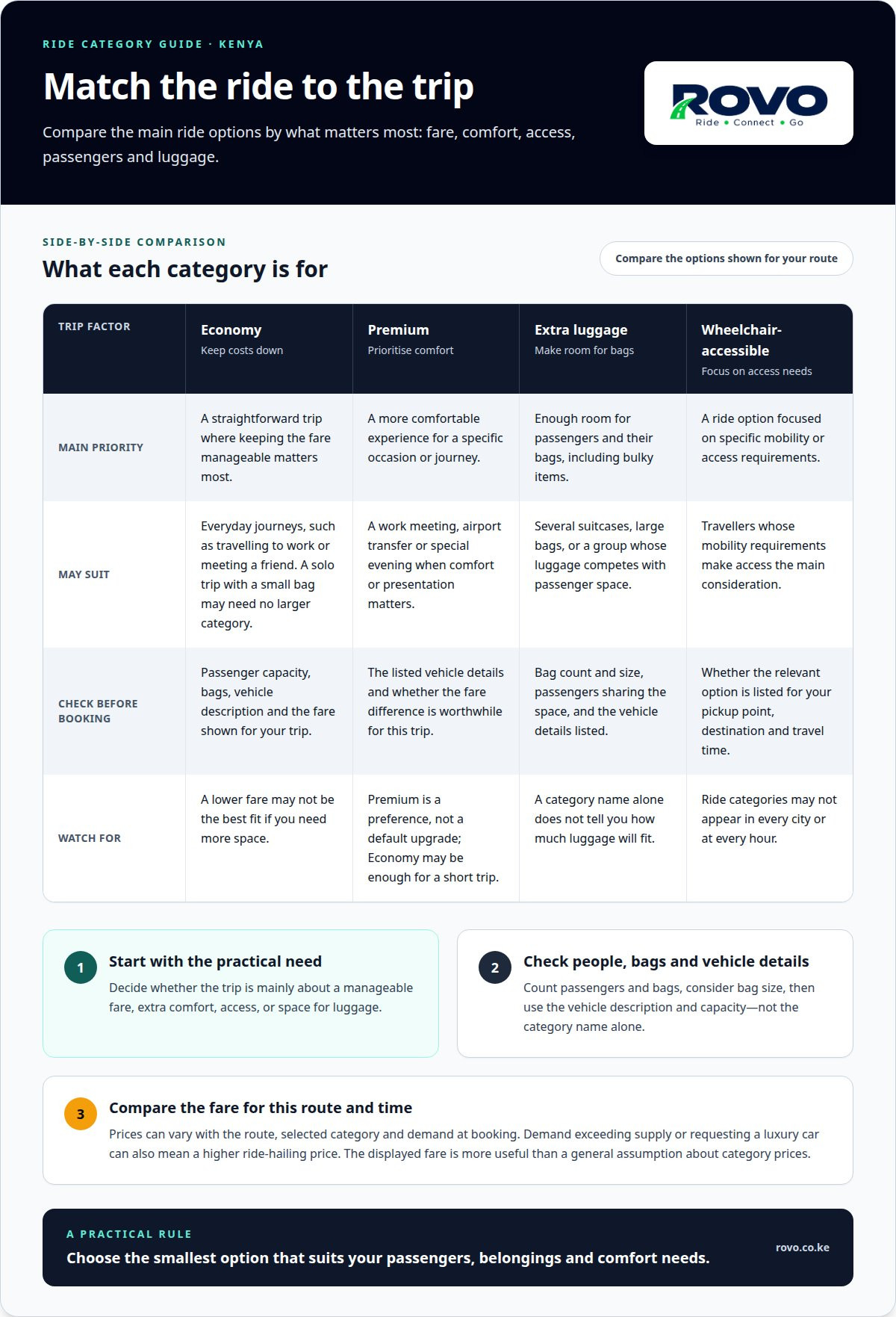
The cheapest ride isn’t always the right fit. To decide how to choose a ride category, match the option to your budget, comfort needs, mobility requirements and luggage. Economy suits a straightforward trip, while a premium ride can offer a more comfortable experience; accessible and extra-luggage options focus on specific travel needs.
It’s easy to focus on the fare and overlook the space or access you’ll need once the ride arrives. A quick comparison can help you weigh each factor before you book. This guide explains how economy, premium, wheelchair-accessible and extra-luggage rides differ, what to consider about fares in Kenya, and how to narrow your choice to the option that fits your trip.
Key Takeaways
- Choose a ride based on the trip’s main need: keeping costs down, adding comfort, supporting access, or making room for luggage.
- Compare the fare shown for your route with the space and comfort you’ll use, rather than choosing on price alone.
- For luggage, consider the number and size of your bags before selecting a vehicle category.
- Use the comparison and decision guide to narrow your options, then book the ride category that best fits your journey.
Economy ride options
Choose Economy for a direct trip where keeping the fare manageable matters most. It can suit everyday journeys, such as travelling to work or meeting a friend. Before booking, consider your passenger count, bags, and comfort needs. A lower fare may not be the best fit if you need more space. For a simple solo trip with a small bag, Economy may suit you without paying for a larger vehicle category.
Vehicle and driver requirements aren’t defined by the economy label alone. Compare the vehicle description and passenger capacity shown for the booking, then review the platform’s stated driver standards. Category names describe ride options, but they don’t establish a separate driver qualification rule. For example, if you’re travelling with another passenger and carry-on bags, check that the listed vehicle can accommodate both before confirming.
Price can reflect your route, selected category, and demand at booking time. According to the European Union, ride-hailing prices can be higher when demand exceeds supply or when a user requests a luxury car. That makes the fare displayed for your specific trip more useful than a general assumption about economy prices. Compare the available economy fare with your route and travel time before choosing.
Ride categories may not appear in every Kenyan city or at every hour. Availability depends on the service area, nearby vehicles, and the time of your request. Check the options shown for your pickup point and destination. If economy appears, compare it with the alternatives listed for that journey. This step helps you avoid planning around a category that isn’t offered for your trip.
- Choose economy when a basic point-to-point journey fits your budget and passenger needs.
- Compare before booking if your party, bags, or comfort needs may require more space.
- Review the trip details to see the fare and categories available for your route.
When deciding how to choose a ride category, start with what the journey requires. Choose Economy when keeping costs down matters most and the option shown suits your passengers and belongings.
Premium ride options
Choose a premium ride when the journey calls for a more upscale vehicle, not simply a lower pickup time. A work meeting, airport transfer, or special evening may make the added comfort worthwhile. Compare the premium option with economy for the same route, then decide whether the difference matters for this trip. Premium is a preference, not a default upgrade for every journey.
Start with the details shown for each category. Consider the vehicle option and passenger space, rather than assuming the category name identifies an exact model or cabin setup. If you’re travelling in formal clothes, a more comfortable option may suit the occasion. For a short trip, Economy may be enough.
Premium fares can change with the vehicle requested and conditions at booking. According to the European Union, ride-hailing prices can be higher when demand exceeds supply or when a user requests a luxury car. Compare the displayed fare for your route and time before selecting. Avoid assuming that the same category costs the same across different journeys.
Use this quick check before booking:
- Match the occasion: Decide whether comfort or presentation matters for this specific trip.
- Review the vehicle details: Use the listed description, not just the premium label.
- Compare the fare: Weigh the shown price against the benefit you expect.
Premium may be a poor fit if your main priority is the lowest fare or carrying bulky items. In those cases, compare the economy or luggage-focused options instead. For a longer journey, factor in how much time you’ll spend in the vehicle. For a brief hop, focus on the route and practical needs first.
Before choosing, compare the available ride categories for your trip. Pick premium when its listed vehicle and comfort details match the reason you’re travelling, and the fare suits your budget.
Ride types with extra luggage space
Choose a larger vehicle option when bags may compete for passenger space. A solo traveller with a large suitcase may need a different option from two people carrying small backpacks. Count your bags, note any bulky items, and review the vehicle details before booking. A category name alone doesn’t tell you how much luggage will fit.
For airport transfers in Kenya, the best category is the one that fits every passenger and bag comfortably. If you’re travelling with several suitcases, prioritise a ride described as offering extra luggage space, or consider a larger vehicle category where available. A passenger travelling alone with one cabin bag may not need the same space.
Use this simple luggage check before selecting:
- Count the bags: Include suitcases, backpacks, and any bulky item.
- Consider their size: A large hard-shell case takes more room than a small soft bag.
- Allow for passengers: Luggage shares space with everyone riding.
- Compare categories: Choose the option whose listed vehicle suits your group and belongings.
For example, a family travelling with several suitcases should prioritise space over the category label. A traveller carrying only a laptop bag can focus on other needs. For a long-distance journey, both comfortable seating and room for luggage may matter. Weigh these needs before booking.
Think about the return journey, too. Airport arrivals may involve extra bags, and anyone travelling with you may bring their own belongings. A vehicle that fits the group but leaves little room for bags can make the ride uncomfortable.
Compare the vehicle options and fares shown for your route. Choose the smallest option that suits your passengers and luggage, rather than paying for space you won’t use. For oversized or unusually shaped items, consider the vehicle details, not just the category name.
What is the difference between economy, comfort, premium, and XL rides?
Ride categories signal different priorities, but names alone don’t define every vehicle’s features. Compare the options and fares shown for your route before booking. A short solo trip and a group journey with suitcases call for different choices.
| Category | Main priority | Best fit |
|---|---|---|
| Economy | Keeping the fare lower | Everyday trips with basic space needs |
| Comfort | A more comfortable ride | Journeys where extra comfort matters |
| Premium | A more upscale vehicle | Work meetings or special occasions |
| XL | More room for passengers or bags | Groups or trips with bulky luggage |
Economy prioritises the fare over added comfort or space. Comfort puts the ride experience first, while premium points toward a more upscale vehicle. The European Union notes ride-hailing prices can rise when demand exceeds supply or someone requests a luxury car. That doesn’t set a fixed price difference between categories in Kenya, so compare the fare shown for your particular journey.
XL describes a space-focused choice. Check its vehicle description and passenger capacity rather than assuming every XL ride fits the same number of people or bags. For example, a group travelling to an airport should consider both passengers and suitcases. A solo passenger with a small backpack may not need that extra room.
To decide how to choose a ride category, rank your needs: fare, comfort, vehicle style, then space. Pick the category that meets your top priority without paying for features you won’t use. If two options seem suitable, compare their displayed descriptions and fares for the same pickup and destination.
Compare ride options for your trip and select the category that matches your passengers, luggage, and comfort priorities.
ROVO: ROVO ride-booking app
ROVO’s ride-booking app lets you book a ride and choose from Economy, Comfort, and SUV options. Compare them against your priorities, such as fare, comfort, and luggage space. With quick booking, real-time trip tracking, and verified drivers, the app helps you manage key trip details in one place.
Choose the category that matches your journey, then review the options shown for your ride. Economy may suit a simple everyday trip, while Comfort or SUV may better fit your comfort or space needs. Your choice depends on the options and fares displayed for that booking.
Ready to plan your next ride? Visit ROVO.
Make your next booking with confidence
Make choosing a ride a simple habit: pause before booking and picture the full journey, from pickup to arrival. A weekday commute may call for a different option from a family airport trip or an evening out. Let the journey guide your choice, rather than automatically choosing the same category as last time.
That’s a practical way to approach how to choose a ride category. Start with what matters most for this journey, then compare the options shown for your route. If your needs change, adjust your selection. A little planning can help you find a ride that fits your day.
For your next trip, use the ROVO ride-booking app to put that choice into action. If you also need to move an item rather than travel yourself, ROVO offers delivery solutions. Take the next step at Contact ROVO about your ride, and set your journey in motion.
Frequently Asked Questions
How many passengers and how much luggage fit in each ride category?
Capacity depends on the specific vehicle, not just its category name. Review the passenger and vehicle details shown before booking. For example, a group travelling with several suitcases needs to account for both seating and luggage space. Count passengers, note bulky bags, and choose an option that suits everyone without relying on luggage being squeezed into passenger space.
How do I choose a ride category in a ride-hailing app?
Enter your pickup and destination, then compare the available categories and fares. To decide how to choose a ride category, start with your main need: budget, comfort, or space for people and bags. A solo commute with a small bag may call for a different option from a family trip with several suitcases. Review the trip details before confirming.
What safety and accessibility features should I consider when choosing a ride category?
Prioritise features that support a safe and comfortable trip. ROVO offers verified drivers, real-time trip tracking, and emergency support. Share trip details when needed, and consider whether the vehicle option suits everyone travelling. If a passenger needs wheelchair-accessible features, don’t assume a larger category alone will provide them.


